Industry Knowledge
Security guard schedule template: how to cover a post 24/7
A security guard schedule template for 24/7 posts: the hours to cover, 8 and 12 hour rotations, relief and open shifts, and a two-week sample to copy.
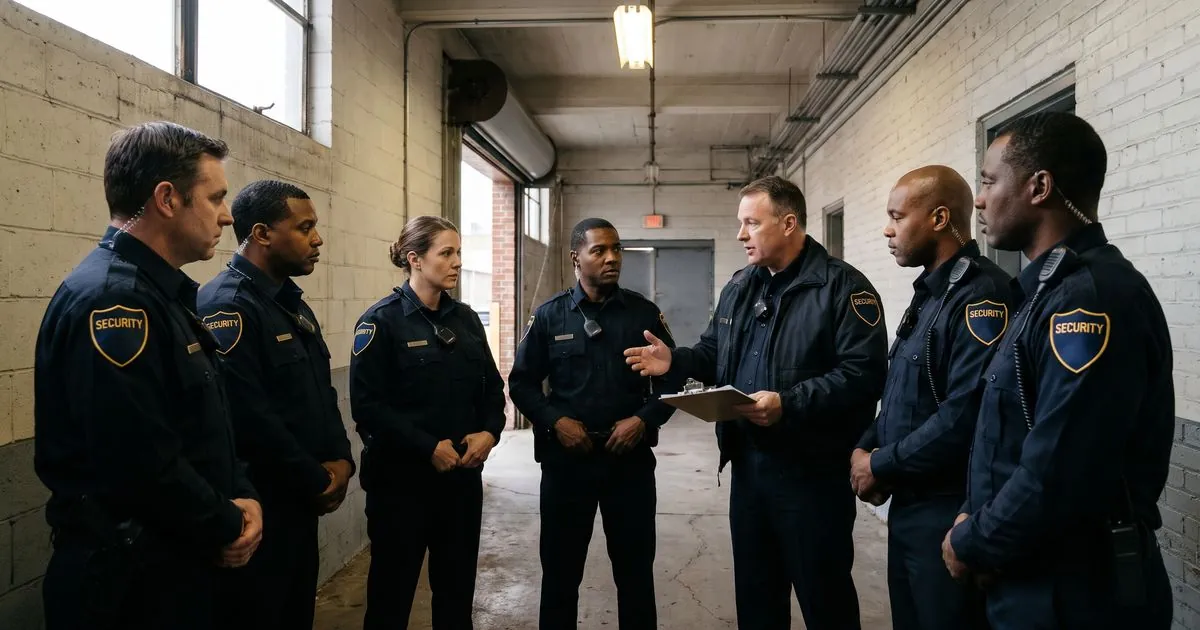
A security guard schedule template turns a client's coverage into shifts that real people can work. For a post staffed around the clock, start with the hours, pick a rotation that fits your officers, then plan relief and open shifts before the first week goes out. The sample at the end covers one 24/7 post for two weeks.
Key points#
- A post staffed 24 hours a day, 7 days a week needs 168 hours of coverage every week.
- Eight-hour rotations use three shifts a day, while 12-hour rotations use two.
- Four officers on a common 12-hour rotation average 42 hours a week each.
- Relief, training shifts and callouts belong in the template, not in a scramble on the day.
- Publish the schedule early and post every gap as an open shift.
Step 1: count the hours the post needs#
Every schedule starts with arithmetic. A day has 24 hours and a week has 7 days, so one post staffed around the clock needs 168 hours a week. Two officers on the same post need 336.
Divide the hours by the week you want each officer to work. At 40 hours, a 24/7 post needs 4.2 officers. That fraction is the reason four full-time officers never quite cover a post on their own: someone works extra hours, or a relief officer fills the gap.
| Coverage | Hours a week | Officers at 40 hours |
|---|---|---|
| 24/7, one officer | 168 | 4.2 |
| 24/7, two officers | 336 | 8.4 |
| Nights only, 6 p.m. to 6 a.m., every day | 84 | 2.1 |
| Weekdays 7 a.m. to 7 p.m. | 60 | 1.5 |
Then add the hours that do not show on the client's order. A 15-minute handoff at each shift change adds 3.5 hours a week on a 12-hour rotation and 5.25 hours on an 8-hour one. New officers need shadow shifts before they work a post alone, and those hours cost the same as any other.
Step 2: pick a rotation#
Eight-hour shifts#
Three shifts cover a day: for example days from 7 a.m. to 3 p.m., swing from 3 p.m. to 11 p.m. and nights from 11 p.m. to 7 a.m. That makes 21 shifts a week on one post.
Four officers working five shifts each cover 20 of them. The 21st shift, 8 hours, goes to a part-time or relief officer. Shorter shifts keep officers fresher and make a callout easier to fill, but they mean three handoffs a day and more people to train on the site.
Twelve-hour shifts#
Two shifts cover a day, often 6 a.m. to 6 p.m. and 6 p.m. to 6 a.m., which makes 14 shifts a week. A common pattern is 2-2-3, sometimes called the Panama schedule: two teams of two officers, one on days and one on nights, work two days, take two off and work three, then run the same blocks the other way round: two off, two on, three off.
Each officer works 7 shifts in every 14 days. That is 84 hours over two weeks, or 42 hours a week when the two weeks are averaged. Officers also get every other weekend off, which helps when you hire.
The catch is the week itself. Federal overtime rules treat 40 hours as the most a covered employee can work in a workweek without overtime pay, the federal regulation says. Each workweek stands alone, and hours cannot be averaged over two weeks, under a related section.
So the same rotation can cost different amounts. In the sample below, with a workweek that starts on Monday, each officer works 60 hours in one week and 24 in the other. With a workweek that starts on Wednesday, the same shifts split into 48 and 36. A workweek can begin on any day and at any hour, but once it is set it stays fixed, and a change must be permanent and not meant to avoid overtime, the regulation on workweeks says.
State and local laws can also require overtime figured on other bases, and following a state law does not excuse breaking the federal one, the federal rules note. Choose your workweek when you set up the rotation, and check it with an attorney or your state labor agency before you rely on it.
Fixed or rotating#
Fixed shifts keep each officer on the same hours, so nights stay with the officers who want them. Rotating shifts move officers between days and nights, which shares the hard hours but is harder on sleep. Ask your officers before you decide, because the answer affects who stays.
Step 3: plan relief, training and callouts#
A relief officer knows several of your sites and fills days off, vacations and sick calls. On 8-hour shifts, each 24/7 post leaves one 8-hour shift a week uncovered by its four regular officers. Five posts like that add up to one full 40-hour relief job.
Write these into the template before the week starts:
- Relief: who covers each regular officer's time off, by name.
- Breaks: who relieves the officer on a one-person post, and when. Check your state's meal and rest break rules.
- Training: shadow shifts for new officers, with the trainer named.
- Licenses: only officers whose license fits the post, such as armed posts, go on the schedule.
- Callouts: a call list of officers who have agreed to pick up short-notice shifts.
Step 4: publish early and post the gaps#
Publish the schedule far enough ahead that officers can plan their lives, and keep the date the same every week. Before it goes out, look for shifts with no name, posts with too few officers and officers on approved time off.
Any shift you cannot fill becomes an open shift. List it where officers can see and claim it, with the site, the hours and the pay, and decide who approves the claim. A gap that officers know about is easier to fill than one they hear about at shift change.
A two-week template you can copy#
This sample covers one 24/7 post on 12-hour shifts with four officers. Alex and Blake form one team, Casey and Dana the other. Day shifts run 6 a.m. to 6 p.m. and night shifts 6 p.m. to 6 a.m.
| Shift | Mon | Tue | Wed | Thu | Fri | Sat | Sun |
|---|---|---|---|---|---|---|---|
| Week one, day | Alex | Alex | Casey | Casey | Alex | Alex | Alex |
| Week one, night | Blake | Blake | Dana | Dana | Blake | Blake | Blake |
| Week two, day | Casey | Casey | Alex | Alex | Casey | Casey | Casey |
| Week two, night | Dana | Dana | Blake | Blake | Dana | Dana | Dana |
Repeat the two weeks. Add a row for the relief officer, and mark the shifts that need overlap for a handoff or a trainee.
Keep the schedule honest#
A template only works if the real day matches it. Compare clock-ins with the schedule each week, follow up on late starts, and update the template when the client changes hours.
In Guardix, managers can build shifts from shift templates, see a preview that warns about open and understaffed shifts before they publish, and post open shifts for officers to claim in the app. Scheduling and clock-in sit in the same place as payroll.
Frequently asked questions#
How many guards do you need for 24/7 coverage?#
One post staffed around the clock needs 168 hours a week. At 40 hours per officer that is 4.2 officers, so plan for four full-time officers plus a relief or part-time officer, or four officers who work some extra hours.
What is a 2-2-3 schedule for security guards?#
It is a 12-hour rotation where each team works two days, takes two off and works three, then runs the same blocks the other way round. Four officers cover a 24/7 post, each works 7 shifts every 14 days, and every officer gets every other weekend off.
Are 8-hour or 12-hour shifts better for a guard company?#
Neither is better for every site. Eight-hour shifts are shorter and easier to cover at short notice, while 12-hour shifts mean fewer handoffs and fewer officers to train. Choose by the site, the client's hours and what your officers will work.
Do 12-hour rotations lead to overtime?#
They can. Federal rules count overtime after 40 hours in a workweek, and each workweek stands alone, the regulation says. State rules can differ, so confirm yours with an attorney or your state labor agency.
Sources#
- GovInfo: 29 CFR 778.101, Maximum nonovertime hours, July 1, 2025
- GovInfo: 29 CFR 778.104, Each workweek stands alone, July 1, 2025
- GovInfo: 29 CFR 778.105, Determining the workweek, July 1, 2025
- GovInfo: 29 CFR 778.5, Relation to other laws generally, July 1, 2025
- Scheduling
- Templates
- Operations